
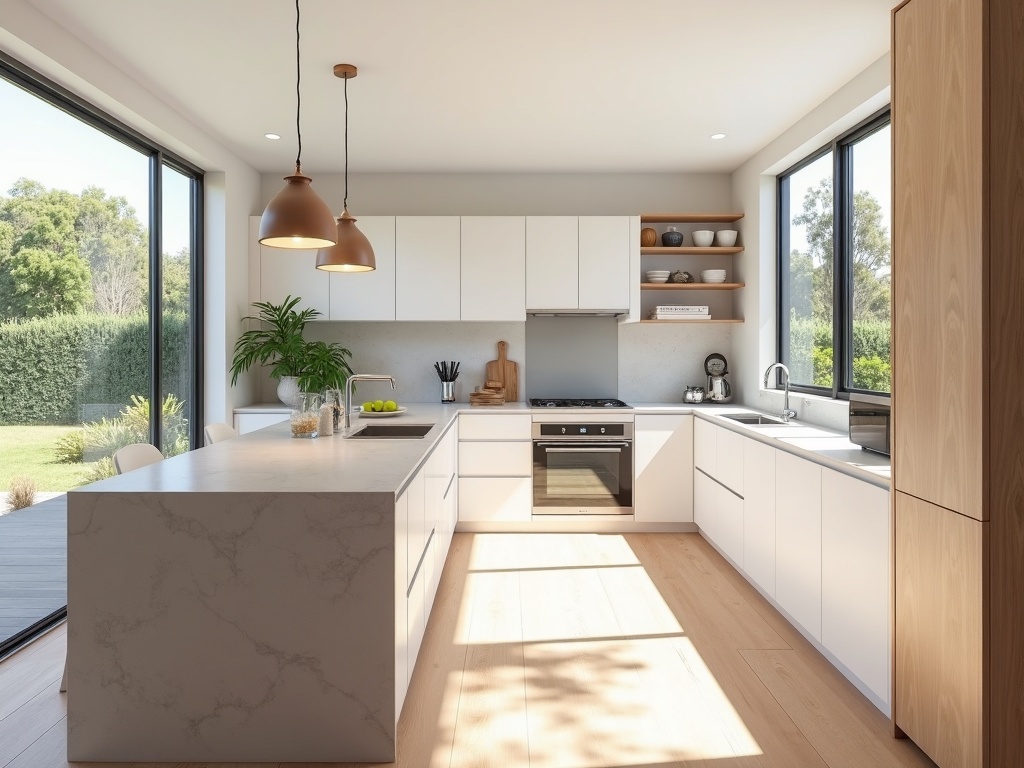
Beyond the Benchtop: Essential Features for a Professional-Grade Home Kitchen
Beyond the Benchtop: Essential Features for a Professional-Grade Home Kitchen
Many kitchen renovations prioritize how the space looks over how it functions. It’s an age-old trap. Maybe they loved the quaint farm sink in that bistro they went to and are now retrofitting it. Who cares if the faucet can only flow at a trickle because it fits so snugly between the wall and the sink? It’s cute.
Start With the Chef’s Path, Not the Work Triangle
The work triangle is tired. It was designed a century ago for a single person standing alone in their kitchen, cooking during their time off from factory work. Not only have our lifestyles changed since then, but the design itself was never based on how people naturally work or interact in the kitchen. In reality, the kitchen is still where everyone gathers, where people work together, and move around each other. With the pan or the cheese grater, back to the spice shelf, drop the whisk, chop on the board.
The thinking starts with the chef’s path, the right per square metre clearance between countertops along the most common walking routes. Paths less than 1200mm wide invariably lead to congestion and frustration, somebody always has to move their bowl of potato salad to let you carry the stockpot to the sink. If you can’t get past the open oven door it doesn’t matter what your bench is made out of. Whether you can easily walk past someone depends on the exact widths given to an island, the distance of a bench from a cooktop, the swing room for dishwasher doors.
Cooking Performance is a Systems Question
Having a high-end cooktop without ventilation to match is a too common and too expensive mistake to make. Homeowners working with new kitchens newcastle specialists know that in an actual high-output kitchen, you need a range hood that’s rated to move enough air to match. That means ducting that’s wide enough and short enough to do the job, not just a decorative hood over inadequate ductwork.
On the cooking surface itself, dual-fuel makes practical sense for anyone working recipes that are in any way complex. An induction cooktop gives you the precise temperature control you need for sauces and all that delicate work; paired with a quality electric oven, you’ll be roasting and baking things more consistently than you would in any single integrated system. These aren’t luxury preferences: they’re what the right tool for the right job looks like.
Surfaces That Hold up to Real Use
This is often where a lot of "professional-grade" kitchen advice falls over. Suddenly it’s all about the aesthetics, marble, timber, statement benchtops, and not the durability.
Natural marble is gorgeous. It also stains from wine, etches from lemon juice, and needs resealing. In a real-life kitchen, that’s a maintenance burden that adds up over the years. Quartz and sintered stone are non-porous, pan-proof (can be put down the second you take them off the stove), and don’t require the constant resealing. They are the commercial-grade option for a reason.
The same applies to cabinetry hardware. Soft-close hinges and drawer glides are not an optional extra. They are a solid construction giveaway and they degrade over a decade of twice-daily use far differently than cabinetry without them.
Storage as Engineered Space
Many bottom shelves are bare because they’re hard to reach. To make the most of storage space in kitchens, it’s best to install pull-out shelving systems with multiple height options and a safety lock to keep them securely in place. More space is wasted in corners where two connecting shelving runs don’t line up with each other (which means it’s impossible to store anything in either of them). To solve this problem, corner units can rotate, extend or you can add a filler piece providing easy access to angled storage.
Tupperware toppling on your head whenever you open a cupboard means it’s time to replace it with racks built specifically for lids and containers. Utensil dividers should be set at a distance that fits everything you use without crowding anything in drawers. And it’s worth remembering that knives rolling loose in drawers aren’t safe or good for the blades.
The engineered "dead" space behind a standard kickboard doesn’t have to be wasted. If your toe-kick space were exchanged for a shallow drawer or lift-up shelf, you could have a place to keep bag clips and oven mitts. Built-in seats can lift for storage as can banquette cushions. Voilà, space!
The Lighting Problem Most Renovations Get Wrong
The overhead lighting typically found in kitchens will not provide enough light to finely chop some garlic, spread butter on a piece of bread, or do any other localized, small, or shaded task. The best solution is to add lighting specifically for these tasks between the face and the work surface. Most cabinets are too high above the benchtop to provide optimal coverage so as a double win, put some lights below them.
What Actually Makes a Kitchen Professional
It’s not the appliances brand or the benchtop material selected from a design magazine. A kitchen earns the label through workflow logic, durable systems, and construction decisions that hold up over years of real use. The finishes matter, but they sit on top of engineering that either works or doesn’t. Get that part right first.
